
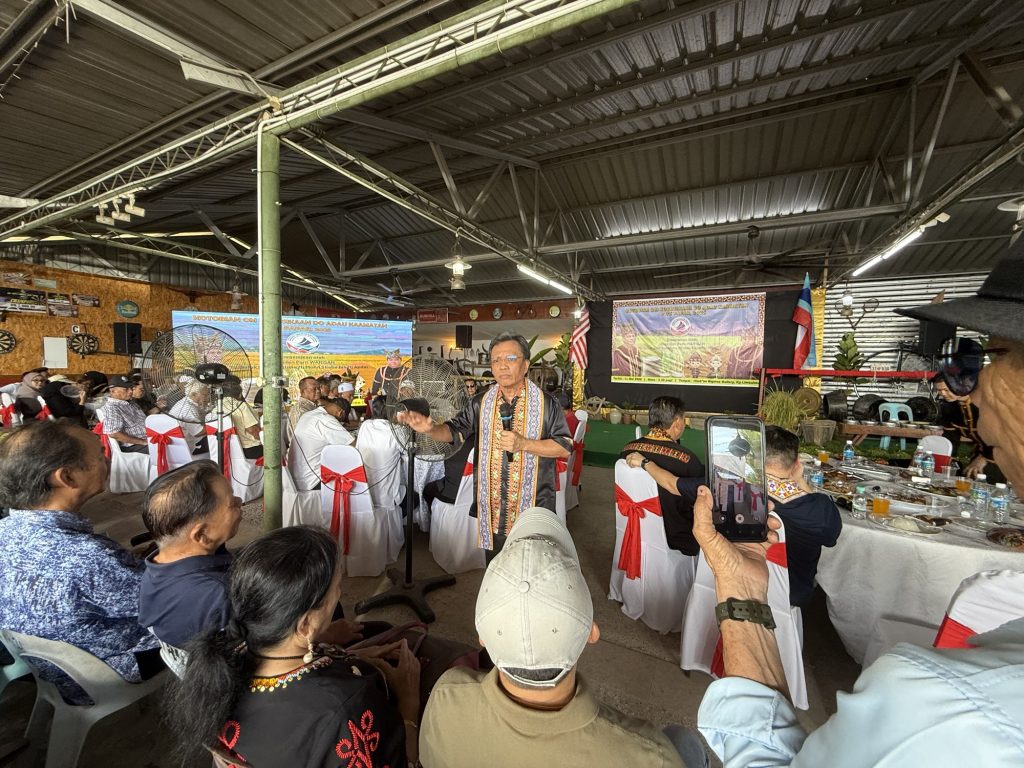
Warisan president Datuk Seri Mohd Shafie Apdal has questioned the Sabah government’s portrayal of economic success, saying the statistics cited by Chief Minister Datuk Seri Hajiji Noor do not reflect the hardships still faced by ordinary people.
Shafie said the recent wave of announcements from Hajiji — first in Sook, then on GDP growth — appeared timed to shape the political narrative ahead of a possible state election.
The Semporna MP said it can be misleading if it were to compare the current administration’s nearly five-year tenure with his party’s short 22-month administration, which took place during the peak of the COVID-19 pandemic.
“They can parade data on TV every day, but the people on the ground are suffering. Prices of goods are high. There are no jobs. Basic infrastructure is not as good as what they claim,” he said during his party’s launch of the Kaamatan Festival in Limbahau Papar.
In Sook on April 28, Hajiji listed infrastructure projects, welfare schemes, and housing initiatives under the Sabah Maju Jaya (SMJ) roadmap, while dismissing opposition criticism as attempts to deny progress.
Two days later, Hajiji also announced that Sabah’s gross domestic product (GDP) had risen to RM83.2 billion in 2023 — an RM1.1 billion increase from the year before — attributing the improvement to long-term strategic planning and effective coordination with the federal government.
Shafie, however, questioned whether those figures captured the lived experience of Sabahans, particularly the unemployed and those in rural areas.
“This is not just a number — it represents thousands of Sabahans, especially our youth, who have been forced to migrate to Singapore, Peninsular Malaysia, or even Hong Kong just to survive,” he said.
Official data from the Department of Statistics Malaysia (DOSM) supports some of his concerns.
In 2019 — Warisan’s final full year in office without the pandemic — Sabah’s GDP stood at RM85.6 billion.
Under GRS, it fell to RM82.1 billion in 2022, before recovering slightly to RM83.2 billion last year, post pandemic.
The state recorded 1.5% economic growth in 2018 under Warisan and 0.5% in 2019, but suffered a –3.9% contraction in 2022 under GRS.
Growth in 2023 rebounded modestly to 1.3%.
Unemployment rose sharply. In 2019, 114,300 people were jobless; by 2024, that number had grown to 181,400 under the current administration — an increase of over 60%.
Inflation, which was 0.2% under Warisan in 2019, spiked to 3.0% in 2022 and remained at 1.5% in 2023.
While acknowledging the government’s development claims, Shafie said statistics alone were not enough.
What concerned him more, he said, was the erosion of public trust amid corruption allegations and the lack of transparency over state resources.
“This corruption is a disease that can destroy society — not just in Sabah, but in Malaysia.
“This corruption, if not addressed with firm legal action, won’t just damage Sabah’s future — it will stain the whole country,” he said.
Shafie referred to ongoing investigations by the Malaysian Anti-Corruption Commission (MACC) involving high-profile graft cases, including one involving a gold-smuggling scandal reportedly worth hundreds of millions of ringgit.
He also raised questions over state-sanctioned timber allocations.
“Hajiji himself said — in 2023 and 2024, they approved 32,000 hectares. I’ve got the documents. Multiply that — it’s nearly 70,000 hectares. Where did it go?” he said.
Shafie questioned why Sabah, despite being the country’s top cocoa-producing state, lacked processing facilities and downstream industries.
“When I was in Kuala Lumpur, we set up processing in Alor Setar. Even Kedah, which doesn’t have cocoa, has a factory. So why doesn’t Sabah — the largest producer — have one?”
He said his own administration, though short-lived, had focused on protecting lives and livelihoods at a time of crisis.
“We went through COVID-19. I spent nearly RM600 million for food baskets. Villages were locked down. Shops were closed. People couldn’t even eat.
“I didn’t wait for KJ (Khairy Jamaluddin, then the federal health minister). I bought masks for school children. I gave RM1 million each to the police, APMM, health services, education, and the military,” he said.
Towards this end, Shafie added that slogans like Sabah Maju Jaya were no substitute for real delivery.
“Slogans won’t fill stomachs. We need leadership that delivers, not just announcements,” he said. – May 1, 2025
