
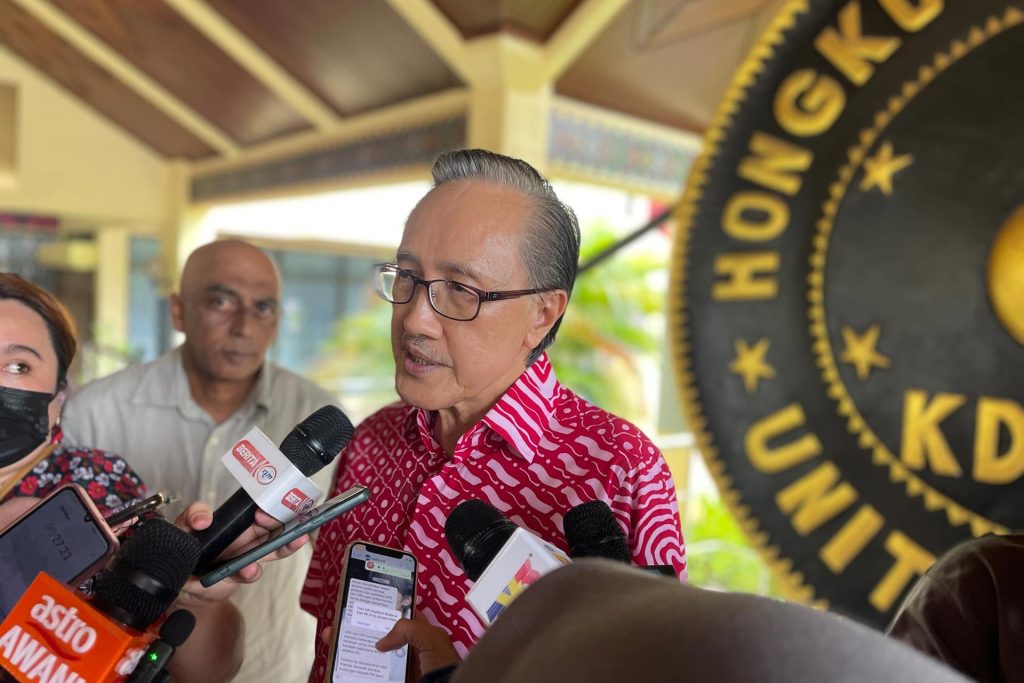
SABAH Finance Minister Datuk Seri Masidi Manjun has defended the decision to raise RM900 million in Sukuk bonds to acquire the debt-ridden Sabah International Petroleum (SIP) as a strategic commercial move.
Speaking at the state legislative assembly on Tuesday, the Karanaan assemblyman from Gabungan Rakyat Sabah explained that the bonds raised by SMJ Energy last year could not be repurposed to address state infrastructure issues.
“The Sukuk issued by a company for business purposes cannot be used for infrastructure projects like building bridges.
“If we were to use it for such purposes, the state government itself would need to raise the bond.
It’s simple to understand that these funds cannot be repurposed as suggested,” he said during the debates on the state supplementary bill in Kota Kinabalu.
Sabah oil and gas firm SMJ Sdn Bhd raised the bonds on October 20 last year with the aim, among others, acquiring SIP, which owes RM1.2 billion to the troubled Sabah Development Bank (SDB).
Masidi said the decision was strategic, as SIP holds a 10% ownership in Petronas LNG9 Sdn Bhd, which operates a plant in the Bintulu LNG Complex in Sarawak.
According to him, SMJ Energy paid off RM700 million of SIP’s debt to SDB to prevent the bank from facing further financial difficulties, reducing the troubled state-bank non-performing loan burden from RM4.5 billion to RM3.9 billion.
This, Masidi said also instilled confidence in the state’s financial standing.
Masidi made these remarks in response to continuous attacks from Sabah opposition leader Datuk Seri Mohd Shafie Apdal (Senallang-Warisan) over the controversial acquisition.
Shafie had alleged that the exercise breached conflict of interest laws and that the money raised should have been used to address state infrastructure issues.
“We must consider both entities. If Sabah Development Bank goes bankrupt, bondholders would sue the owner—who is the state government.
Paying RM700 million benefits both SIP and SDB, as SIP saves RM60 million annually in interest costs, while SDB reduces its interest burden on other loans by RM35 million annually,” said Masidi.
Masidi stated that SIP can yield dividends of at least RM150 million a year for the next 10 to 12 years once all its debts are paid off to SDB.
“This translates to a minimum of RM1.2 billion in dividends over that period.
“However, we couldn’t collect these dividends earlier due to the heavy debt burden,” he said.
Masidi pointed out that Shafie himself had explored the possibility of raising such bonds to resolve the SIP debt problem when he was chief minister in January 2020.
Shafie was Sabah’s chief minister between 2018 and 2020.
“It’s not about personal attacks. It’s about ensuring the best for Sabah. I respect him, but let’s not twist the facts or become enemies of our state.
“He (Shafie) can ask questions, but I urge him to understand our intentions,” said Masidi.
Masidi has noted that Shafie made the matter political when he discussed the SIP matter openly at a Kaamatan celebration organized by Warisan in Penampang recently.
Towards this end, he revealed that Shafie himself did not resolve the burgeoning non-performing loans of SDB when he was chief minister.
“Previous administrations also took no action against defaulting borrowers.
For instance, a borrower was provided a new loan of RM172 million in August 2019 to cover overdue interest, turning a non-performing loan into a performing one.
“However, no legal action was taken when the borrower defaulted again six months later,” said Masidi, adding that he could not reveal the name of the company due to non-disclosure regulations.
Masidi also revealed the true story behind Sabah’s feat to repay the RM1 billion government bond to Putrajaya in 2019.
He explained that the state has established a a sinking fund following the advice of Bank Negara Malaysia when the state government sought funds in 2014.
“Bank Negara advised that to set up the fund to ensure the state government could repay or redeem the bonds when they mature in five years.
“Bank Negara advised subscribing RM200 million annually. So, when the bonds were raised, the state government paid the amount each year.
“Over time, this accumulated to RM1 billion. When the bonds matured in 2019, the state was able to pay them,” he said.
Shafie had described the debt as one of the problems left by the previous Barisan Nasional administration, and it was a “feat” for his administration to settle the dues in 2019.
