
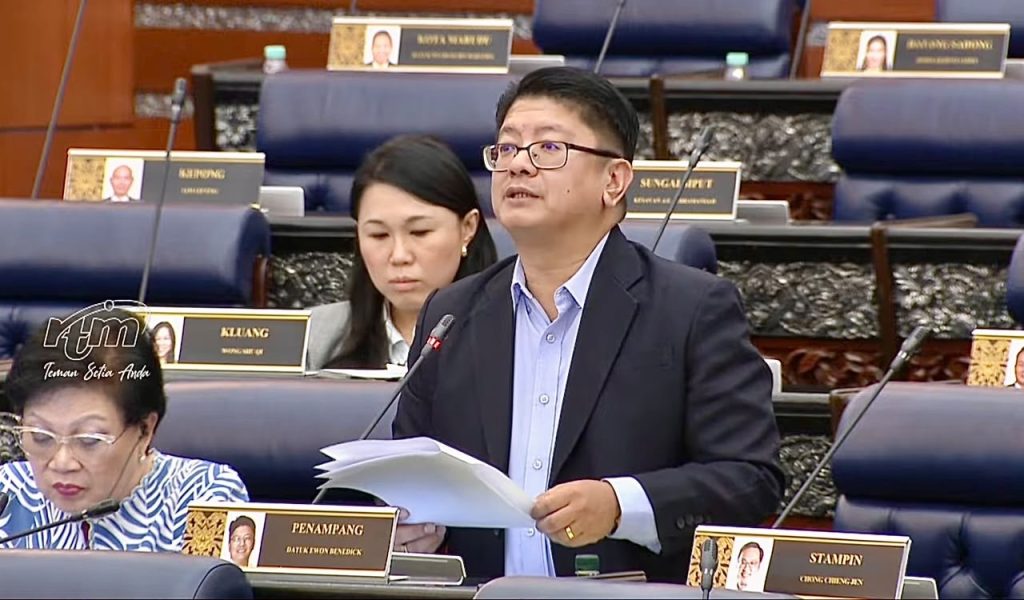
Sabah’s extensive forest coverage means the state’s views should be considered into the formulation of national forestry policies and climate change initiatives, Penampang MP Ewon Benedick says.
He said Sabah and Sarawak should be recognised as key stakeholders in decisions involving forestry, environmental sustainability and carbon markets, given their significant forest resources.
Sabah has forest coverage of 62.53%, while Sarawak has 61.52%, both exceeding the national average of 54.4%.
“This makes Sabah and Sarawak key stakeholders in any legislation, policy and initiative related to forestry, climate change, environmental sustainability and the national carbon market,” he said in the Dewan Rakyat on Wednesday.
Ewon said Sabah’s forest resources would also contribute significantly to Malaysia’s commitments under the Paris Agreement and the United Nations Sustainable Development Goals.
He raised the matter during the committee-stage debate on the 2027 Supply Bill for the Natural Resources and Environmental Sustainability Ministry in Parliament today.
Ewon, who is also Sabah Deputy Chief Minister III and state Industrial Development, Entrepreneurship and Transport Minister, sought clarification on the proposed National Climate Change Bill.
He questioned whether the Sabah government’s views had been taken into account in drafting the legislation, given the state’s role as a major stakeholder.
He also asked the ministry to explain the initiatives introduced following the launch of the National Carbon Market Policy in April.
While land and forestry fall under state jurisdiction, Ewon said closer cooperation between the federal and Sabah governments was necessary to fulfil Malaysia’s international environmental commitments.
He proposed increasing the Ecological Fiscal Transfer (EFT) allocation to Sabah to recognise the state’s contribution to maintaining the country’s forest cover.
He said the funding could serve as an incentive for states that preserved large areas of forest.
On other matters, Ewon called for increased funding to expand tube wells and water filtration systems in rural Sabah, particularly in villages without access to treated water.
He welcomed continued cooperation between the Minerals and Geoscience Department and Sabah’s Rural Development Ministry under the Alternative Rural Water Supply Programme.
He said villages in the hilly areas of Penampang and Kadamaian continued to face water shortages, especially during dry seasons.
Ewon also sought clarification on the RM65 million National Geohazard Study, including the areas to be covered in Sabah and whether its findings would be shared with the state government.
He further raised the rehabilitation of the former Mamut copper mine in Ranau, saying the site should be restored for productive economic use.
On conservation, he welcomed the RM411,000 allocation for Sabah’s Heart of Borneo project but called for additional annual funding to protect internationally recognised conservation areas, including the Kinabalu UNESCO Global Geopark and the Crocker Range.
He also urged closer federal-state cooperation to ensure industrial development does not come at the expense of environmental protection.
He cited Sabah’s planned Blue Economy Industrial Park in Kudat, which will adopt environmentally friendly development, community integration and green technology principles. The proposed park borders the Tun Mustapha Marine Park.
The POIC industrial park in Lahad Datu, meanwhile, is adjacent to extensive mangrove forests that form part of the area’s ecosystem.
Ewon asked the ministry to explain how it could support industrial development while ensuring the protection of surrounding forests and conservation areas.
