
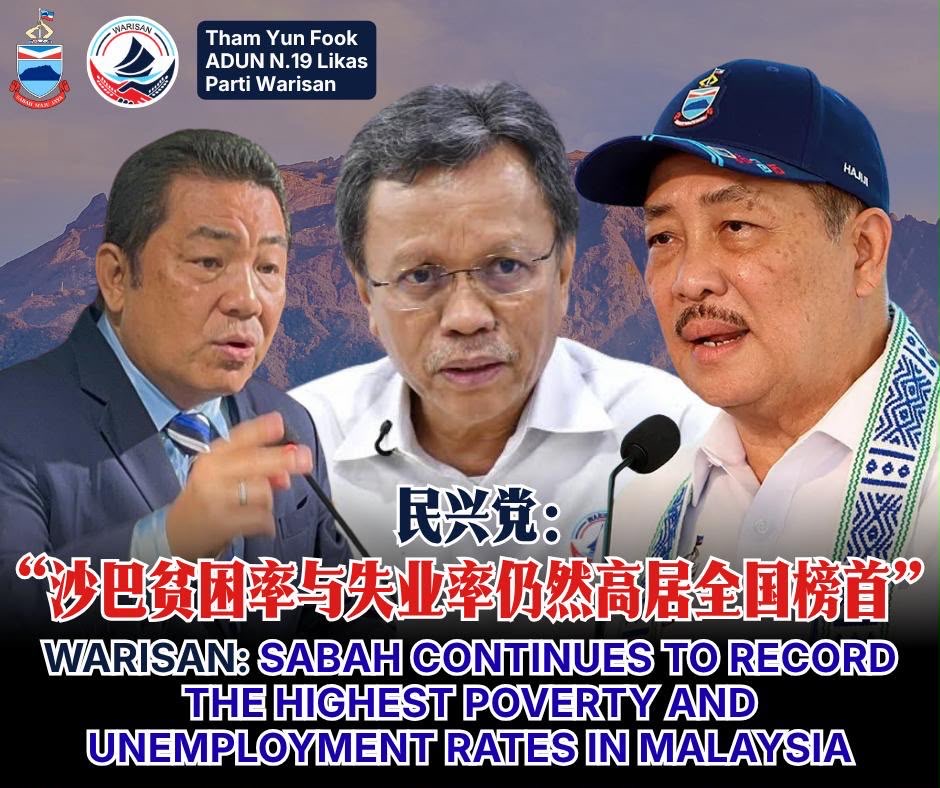
Parti Warisan has questioned the Sabah government’s target of achieving lower hardcore poverty, saying the state continues to record the country’s highest poverty and unemployment rates.
The party’s information chief Tham Yun Fook, said eliminating hardcore poverty did not mean poverty had been eradicated, particularly as thousands of households remained classified as poor.
He said Department of Statistics Malaysia (DOSM) figures showed Sabah’s absolute poverty rate stood at 17.7% in 2024, more than three times the national average of 5.1%.
The latest eKasih data, as of 15 October 2026, also recorded 55,555 poor household heads in Sabah.
Tham said the figures raised questions about the gap between the government’s zero hardcore poverty announcement and the economic circumstances faced by many families.
He recalled that Chief Minister Hajiji Noor had announced on 13 August 2024 that Sabah had no households classified as hardcore poor, based on data as of 31 July that year.
However, Warisan said the government needed to establish whether families had genuinely improved their financial circumstances or had simply been removed from the poverty list following reassessments and data updates.
Tham also referred to Hajiji’s admission in the state assembly in December 2025 that some poor people might not have been captured in official data.
The chief minister had acknowledged that poverty was dynamic, with families potentially falling back into hardship because of unemployment, illness and other financial difficulties.
At a seminar on 17 November, Hajiji said poverty eradication should not be measured solely by the number of assistance programmes, allocations or distribution ceremonies.
RELATED LINK:
“People do not live by programme statistics. They need income, food, shelter, education and hope for the future,” he said.
Warisan said it agreed with the principle but urged the government to demonstrate tangible improvements in household income, employment and living standards.
It also highlighted Sabah’s 7.2% unemployment rate in 2025, compared with the national average of 3%, with about 134,400 people unemployed.
Youth unemployment was another concern, with the rate among those aged 20 to 24 reaching 36.9% in 2024, while the 25 to 29 age group recorded 16.2%.
Tham questioned how many jobs created through major infrastructure, industrial, tourism and energy projects had actually gone to Sabahans.
He also asked how many local graduates secured employment matching their qualifications and how many young people had to leave the state to find work elsewhere.
Hajiji has set a target of reducing Sabah’s absolute poverty rate to between 3% and 5% by 2030.
Warisan said the target required clear implementation plans, annual performance indicators and public accountability.
It called for greater emphasis on stable employment, higher household incomes, basic infrastructure and rural economic development through agriculture, fisheries and small and medium-sized enterprises.
The party said achieving zero hardcore poverty was only one stage of poverty eradication, not the end of the process.
“True success is not measured by how many people are removed from the poverty list, but by how many families genuinely escape poverty and are able to live with dignity and security,” Tham said.
